
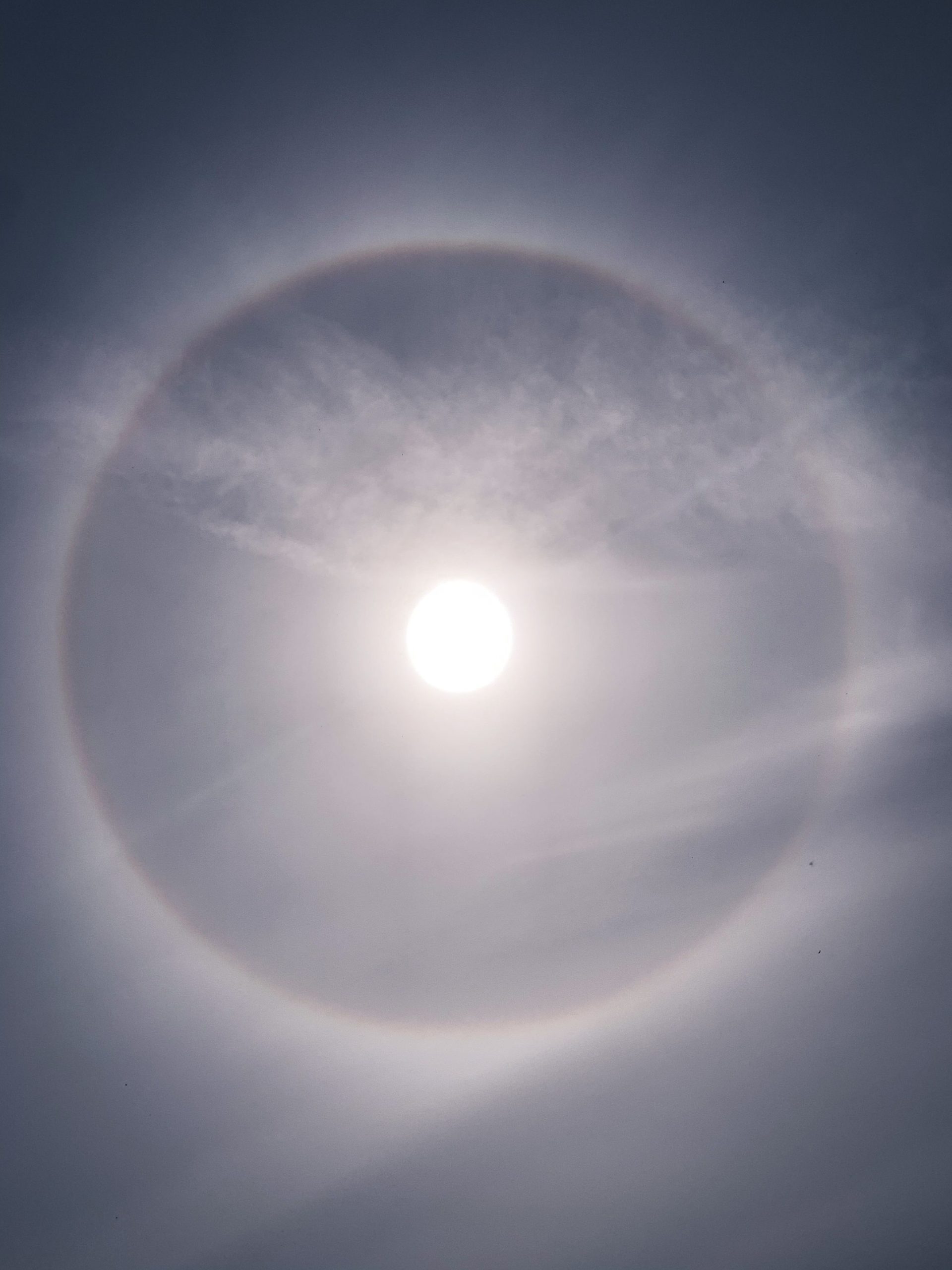
While some observers were left wondering what had caused the colourful display, the explanation is rooted in a fascinating natural phenomenon.
The spectacle, visible over parts of Gauteng and other areas, is known as a 22-degree solar halo. Despite its unusual appearance, it has nothing to do with extraterrestrial activity or changes to the sun. Instead, it is an optical effect created by sunlight interacting with tiny ice crystals high in the Earth’s atmosphere.
What causes a halo around the sun?
According to weather experts, solar halos form when sunlight passes through millions of tiny, six-sided ice crystals suspended in high-altitude cirrus or cirrostratus clouds.
These clouds typically occur between eight and 10 kilometres above the ground, where temperatures are cold enough for ice crystals to form, even when conditions at ground level are warm.
As sunlight enters and passes through the crystals, it bends through a process known as refraction. The light is redirected at a particular angle, creating the distinctive circular ring that appears to surround the sun.
The most commonly observed version is called a 22-degree halo. The name refers to the angle at which the ring appears around the sun from the perspective of someone on the ground.
Although the halo often appears as a bright white circle, it can also display subtle rainbow-like colours. Red is generally visible along the inner edge, while blue and violet hues may appear towards the outside.
Does a solar halo mean rain is coming?
Solar halos are sometimes associated with changing weather conditions. This is because the high-altitude clouds responsible for the phenomenon can develop ahead of an approaching weather front.
According to weather experts, the presence of a halo can indicate moisture and cloud activity in the upper atmosphere. However, it is not a reliable indication that rain will follow.
South Africa’s recent weather conditions, including thunderstorms over parts of Gauteng, have also drawn attention to the atmospheric activity behind the display. Meteorologists have cautioned against interpreting the halo on its own as a forecast of approaching rainfall.
Can you look directly at a solar halo?
Although solar halos are harmless atmospheric phenomena, observing them requires some care.
Experts warn against looking directly at the sun, even when trying to photograph the surrounding ring. Direct exposure to intense sunlight can cause serious and potentially permanent eye damage.
A safer way to observe the phenomenon is to position yourself where a building, tree or another object blocks the sun itself, allowing you to see the halo around it without staring directly at the solar disc.
Solar halos are a reminder of the remarkable natural displays that can occur in our atmosphere. While they may look unusual, the science behind them is a fascinating combination of sunlight, clouds and ice crystals.
This article was originally written by Miriam Kimvangu for Getaway.
Also See: The 11th Floor nabs 4 International awards, including Best Head Chef
The 11th Floor nabs 4 International awards, including Best Head Chef
