
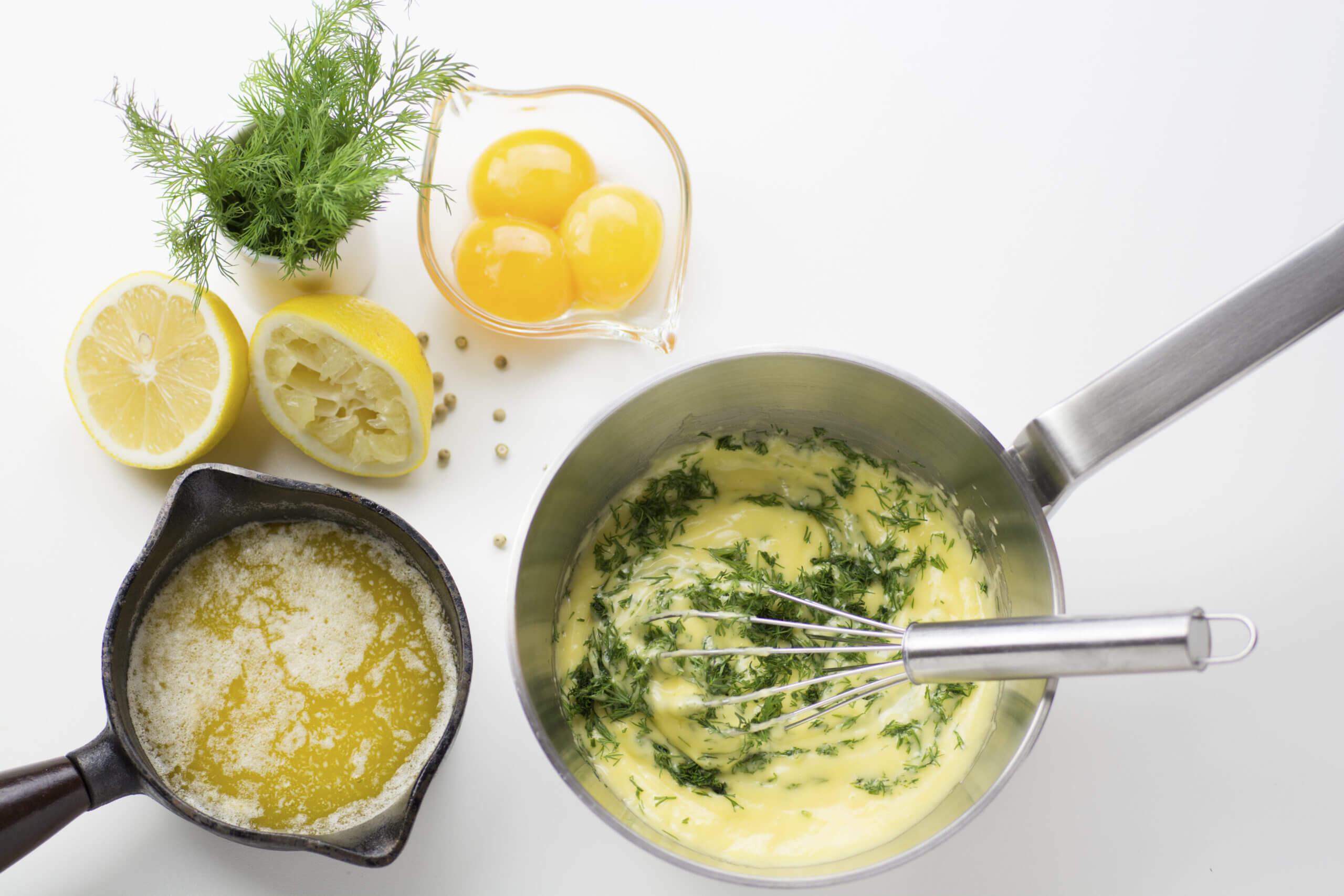
Mother sauces are hundreds of years old, and are still used as foundations for many of the dishes we eat today.
Unlike the makeshift gravy your grandmother or mom makes, mother sauces were created and refined by the French culinary master himself, Chef Marie-Antoine Carême, back in the 19th century. Although Chef Carême refined four sauces, in the 20th century, Chef Georges Auguste Escoffier updated this list in Le Guide Culinaire, adding his very own sauce Tomat.
But what do we mean by ‘sauce’? In terms of mother sauces, a sauce is a liquid thickened with a thickening agent and flavoured with herbs and spices. For instance, a gravy made from stock and a roux is a sauce, but a vinaigrette, made from oil and vinegar, is not.
What differentiates the five mother sauces is the flavour profile, consistency, and thickening agent used.
The five mother sauces
1. Béchamel “beh(y)-shah-mehl”
One of the most common of the sauces, béchamel, is basically a light roux. It’s used in dishes like potato gratin and mac ‘n cheese, as well as the famous Croque Monsieur and arrancini (risotto balls).
First, butter is melted, then flour is whisked in. This mixture is cooked out on low-medium heat for a couple of minutes before slowly pouring in warm milk, all while whisking continuously to prevent lumps. It’s finished with salt and pepper seasoning, and that’s it. Most recipes call for a touch of nutmeg, too.
Variations: onion puree is added to make soubise (served with pork and chicken) or cheese is added to make the famous cheese/mornay sauce.
2. Velouté “veh-loo-tay”
This sauce has the same basic steps as a béchamel, only with a few tweaks. It’s one of the most versatile mother sauces, with a long list of variations.
First, the roux is made (with melted butter and flour). However, this mixture is cooked for longer to turn it from a pale colour into a light golden colour. Then, instead of milk, you slowly whisk in stock (usually a bone stock made with veal, lamb or chicken). And that’s it. Since the stock is already salty, this sauce might only need some pepper as seasoning.
The stock creates a thinner and smoother texture. After all, velouté is French for velvet.
Variations: daughter sauces include Sauce Allemande (lemon, egg yolk and cream), Sauce Normandy (egg, butter and cream), and a basic wine sauce.
3. Espagnole “es-pahn-yole”
Espagnole is the final sauce of the five made with a roux. It’s darker than the others and served with chicken or beef dishes.
First, the roux is made. Instead of turning it into a pale golden colour, it’s cooked for much longer until it’s dark brown. Next, a mirepoix (celery, onion and carrots) and tomato puree is added and cooked out. Herbs are added before whisking in brown stock (made from beef bones). The resulting flavour is strong and intense, so chefs usually add other ingredients or processes to it before using it in dishes.
Variations: Madeira (added Madeira wine), Mushroom sauce (added mushrooms), and demi glace (additional stock and sherry, reduced to thicken).
4. Sauce Tomat “toh-maht”
Commonly referred to as ‘red sauce’, sauce tomat was the OG base for modern pasta sauces.
Refined by Chef Escoffier, this sauce includes sauteeing tomatoes, herbs, carrots, onion, and garlic in butter until soft. Next, flour is added and cooked out before veal broth is stirred in. This is simmered until reduced or thickened.
Variations: puttanesca (olives and capers), Creole sauce (creole spices), marinara (splash of wine), bolognese (beef mince or stew meats).
5. Hollandaise “holland-ayez”
One of the most famous sauces, best known for the dish Eggs Benedict, hollandaise has a reputation: it’s quite tricky to perfect.
First, egg yolks and an acid, usually vinegar or lemon juice, are whisked together in a bain marie. Then, very slowly, melted and clarified butter is whisked in. This action (adding fat to fat and acid over heat, with agitation) causes the ingredients to emulsify (combine) and thicken. The result is a thick, smooth and silky sauce. Salt and pepper are added as final touches. It is commonly served with poached eggs, asparagus, and poached fish.
Variations: Béarnaise (tarragon, shallots and vinegar reduction) and Mousseline (whipped cream).
